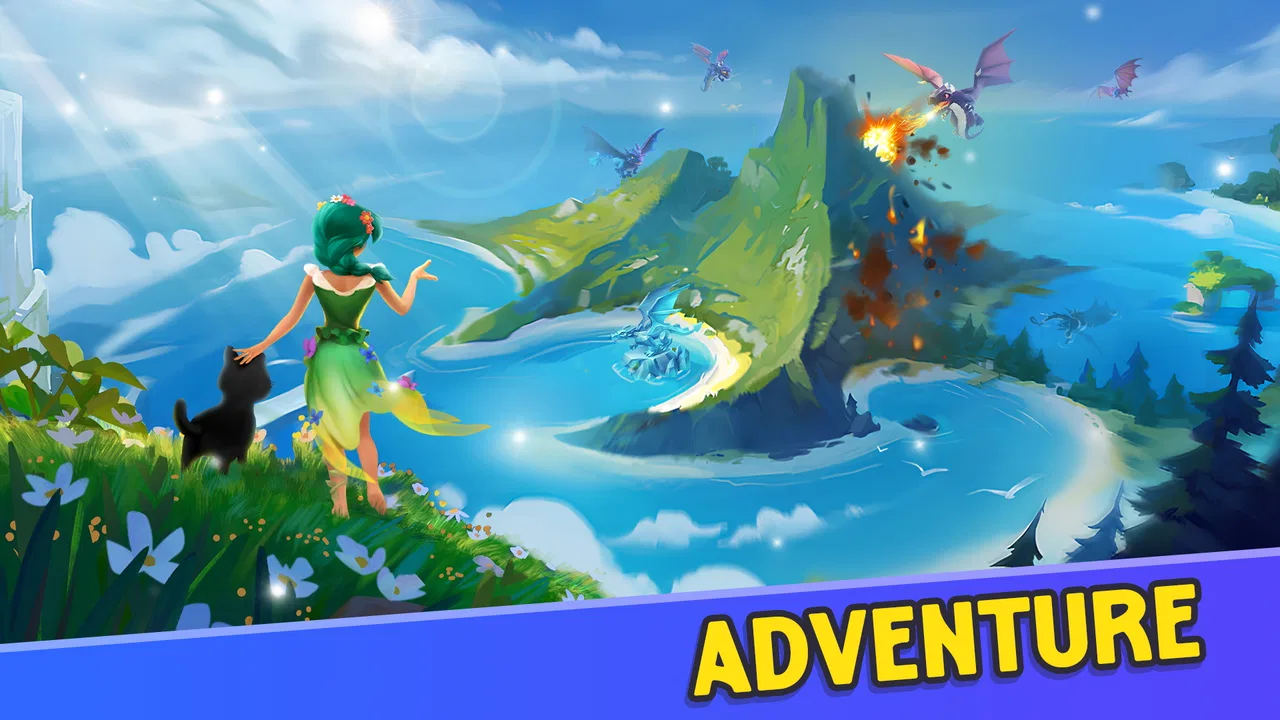
Merge Neverland
- 4.5
- Rating
- 1.00M
- Installs
- Free
- Price

 Analysis by App-foxy
I spent time with Merge Neverland as a relaxing casual game, and its central appeal is easy to understand: you combine matching objects to gradually shape your progress through an elf-themed world. That sounds simple, but the quality of a merge game depends on how well it turns small decisions into a satisfying routine. In my experience, this one works best when I treat it as a short, thoughtful break rather than a game I need to rush through.
The game is free to download, made by IVYGAMES, and aimed at Everyone. It has already passed one million installs and holds a 4.5 average from around sixteen thousand ratings, which fits my impression that it is designed for a broad audience rather than for highly competitive players. It is available for devices running Android 7.0 or later, and the current version is 2.2.9.
Why the merging mechanic carries the experience
The important capability here is not simply matching identical pieces. It is deciding when a merge is helpful and when keeping separate items gives me more flexibility. Each combination changes the space available on the board, so a move can solve an immediate problem while creating a more awkward one a few turns later.
You May Also Like

 Blood Strike: 2.5 Anniversary
Blood Strike’s Loadouts Turn Every Drop Into a Tactical Gamble
A close look at Blood Strike’s custom loadouts: how fast access to signature weapons reshapes its battle royale rhythm, rewards preparation, and narrows the gap between fights.

 Pandora - Music & Podcasts
Pandora’s Music Is Easy to Start, but Harder to Recover
Pandora’s strength is its low-effort path from a seed to a station. Its weak spot is how much confidence it asks you to place in connection, setup, and quiet recovery.

 8 Ball Pool
 Is Built on Rivalries, Rematches, and Routine
A close look at the rivalries, rematches, shared routines, and unanswered safety questions that turn a quick pool match into a persistent mobile community.

 Samsung Music
’s Quiet Strength Is Playing What You Already Own
Its reach comes less from spectacle than from dependable access to a personal library. That simplicity is both the app’s strongest retention engine and its ceiling.

 AccuWeather: Weather Radar
AccuWeather Review: A Quick, Clear Forecast for Everyday Decisions
For everyday plans, the best forecast is the one you can understand quickly. AccuWeather makes rain timing, radar, and local conditions easy to act on, with a few trade-offs.

 Hill Climb Racing
Why Hill Climb Racing Still Turns Crashes Into One More Run
A tiny car, a bumpy hill and one more upgrade: Hill Climb Racing keeps resurfacing because its simple chaos makes every near-miss feel personal.
More From Our News Desk



That makes the game more interesting than a purely automatic chain of taps. I regularly find myself looking beyond the most obvious pair. If I combine two items immediately, I may open a useful space, but I may also lose the chance to create a larger combination later. The best move is often the one that keeps several possible merges available instead of producing the biggest object as quickly as possible.
This is where the elf-world setting earns its place. The visual theme gives the otherwise abstract collection of objects a sense of purpose. I am not just clearing a board; I feel as though I am gradually helping a small fantasy environment develop. The setting does not turn the game into a role-playing adventure, but it gives the repeated merge cycle more personality than a plain puzzle grid.
The real strength is controlled progress: every small combination makes the board feel more manageable, while larger combinations provide a clear reason to plan ahead. That balance is what kept me returning after the novelty of the theme had worn off.
How a typical session feels
I usually begin by scanning the whole play area rather than tapping the first available match. That quick pause matters. I look for groups that can be combined in stages and for objects blocking the most useful part of the board. When several choices are available, I prioritize the move that creates room without destroying a promising chain.
In practice, the game is comfortable in short sessions. I can make a few decisions while waiting for a train, taking a coffee break, or winding down before bed. It does not demand the same uninterrupted attention as an action game, and that makes it suitable for players who want something gentle. At the same time, the board can become surprisingly absorbing when several possible combinations are visible at once.
A useful habit is to avoid filling every open area with newly created objects. Empty space is not wasted space in a merge game; it is a resource. I get better results when I leave a little room for an unexpected combination instead of arranging everything tightly. This is one of the less obvious lessons of the game, because a crowded board can look productive while actually reducing my options.
I also recommend pausing before a large merge. A bigger object may look like an obvious improvement, but the result can change the shape of the board and interfere with a nearby chain. When I first played, I treated every available combination as progress. Later, I started treating some combinations as preparation, and that made the play feel less random.
What the elf setting adds to the routine
The fantasy presentation gives the repeated actions a softer mood. I found it easier to play for a few minutes without feeling pressured to master a complicated system. The game’s casual classification is accurate: its appeal comes from steady organization and gradual discovery, not from demanding reflexes or deep competitive strategy.
That also explains its limits. Players who need constant surprises, fast combat, or a strong narrative may find the experience too quiet. The elf theme is pleasant, but it does not replace the variety of a full adventure game. I would recommend it to someone who enjoys arranging, collecting, and improving a space in small steps, not to someone looking for a story-heavy fantasy journey.
The presentation is at its best when I let the game remain a background-friendly activity. I can focus on the board, make a few careful decisions, and stop without feeling that I have abandoned a complicated mission. That low-pressure structure is a genuine advantage for casual players, especially those who prefer games that respect irregular play sessions.
The most useful everyday scenario
My favorite way to use Merge Neverland is as a ten-minute reset between tasks. After finishing a piece of work, I can open it, inspect the board, make a few planned merges, and close it again. Because the main interaction is easy to understand, I do not need to spend the first minute remembering a complicated control scheme.
The game is also a good fit for a shared device used by different members of a household. The Everyone age rating and straightforward controls make it approachable for a wide range of players. I would still encourage younger players to use the purchase controls carefully, because the game includes optional in-app purchases ranging from $0.99 to $99.99 per item. The free entry point is attractive, but the presence of purchases means it is worth setting expectations before handing over a device.
For me, the best session is not the longest one. If I continue playing after the board becomes crowded and I am making hurried decisions, the relaxing quality fades. Short visits let the merge mechanic stay satisfying. This is a useful distinction: the game can fill spare moments very well, but it is not necessarily the best choice for an all-evening gaming session.
Where the friction appears
The same repetition that makes the game calming can eventually make it feel predictable. Merging similar objects is satisfying when I am working toward a clear improvement, but the pattern can lose energy if I expect constant novelty. The game is strongest for players who enjoy incremental goals; it is less convincing for anyone who needs dramatic changes from one minute to the next.
Board management is another trade-off. Planning creates satisfaction, but it also means that careless taps can leave the play area less useful. I sometimes reach a point where I have several partial groups but not enough room to arrange them comfortably. That is not a flaw in the basic idea, yet it can feel restrictive when I have created the problem through an earlier impulsive merge.
I also think the free-to-play structure deserves a realistic look. The game costs nothing to start, which makes trying it easy, but optional purchases can become more tempting when progress slows or the board feels constrained. I would not approach it expecting every part of the experience to remain equally fast without spending. Anyone who prefers a fixed-price game with no purchase decisions may be happier elsewhere.
Compared with a traditional match-three puzzle, this game feels more like managing a growing collection than clearing a sequence of isolated stages. A match-three alternative is usually better when I want quick rounds, immediate scoring, and a simple restart. Merge Neverland is better when I want my earlier decisions to matter and enjoy seeing a space develop over time.
Compared with a larger fantasy game, it is much easier to pick up and put down, but it offers less narrative weight and less mechanical variety. A role-playing game would suit me more when I want character progression, battles, and a story to follow. Here, the reward is the gradual transformation of the board and the satisfaction of making room for the next useful combination.
Small habits that improve the experience
My first practical tip is to scan before acting. I look for the most crowded area, the groups closest to a useful chain, and any move that opens space without breaking another possibility. This takes only a moment but prevents the common mistake of spending a valuable position on the easiest visible match.
My second tip is to think in layers. Instead of asking which two objects can merge now, I ask which combination could lead to a stronger result after another step. I do not follow that plan blindly, because the board can change, but keeping a possible sequence in mind makes the game feel more deliberate.
My third tip is to treat empty space as a future move. When I leave room around active groups, I have more freedom to respond when new objects appear. This is especially helpful during a short session, because I can stop with a clean board rather than leaving a tangled arrangement that makes the next visit less inviting.
A fourth useful habit is knowing when to stop. If I am no longer considering choices and am simply tapping to clear the screen, I close the game. The design works as a calming break, and forcing extra progress can turn that strength into fatigue. This is one reason I would recommend it for regular short visits rather than uninterrupted grinding.
Who will get the most from it
I think Merge Neverland is a good match for someone who likes casual collection games, gentle fantasy settings, and puzzles that reward patience more than speed. It is particularly suitable for players who enjoy arranging a messy space into something more organized. The game gives those decisions enough consequence to feel meaningful without becoming difficult to understand.
It can also work for families and occasional players because the controls are approachable and the age rating is Everyone. Still, younger users may need supervision around the optional purchases, and players who are easily frustrated by slow progress should decide in advance whether they are comfortable playing without buying anything.
I would skip it if my priority were competitive rankings, rapid action, or a substantial story. I would also choose a different casual game if I wanted very short, self-contained rounds with no ongoing board to manage. The appeal here depends on enjoying continuity: each session feels connected to the last because the arrangement and decisions carry forward.
The game has attracted a substantial audience, with around sixteen thousand ratings and more than one million installs, but those figures do not change the basic question of fit. Popularity can suggest that the format works for many people; it cannot make a merge loop enjoyable for someone who dislikes repetition. I would use the free price as an invitation to test the rhythm rather than as a reason to assume it will suit everyone.
My recommendation after playing
Merge Neverland succeeds because it understands the appeal of a small, visible improvement. I can open it with no complicated preparation, make a few choices, and leave with the feeling that I have organized something. The elf-world presentation supports that mood, while the merge mechanic gives me just enough planning to keep the routine from becoming mindless.
My honest recommendation is to try it if you want a calm casual game for spare moments and enjoy planning around limited space. Keep purchases in mind, avoid rushing every available combination, and give yourself permission to stop after a satisfying sequence. If you want fast rounds or a deeper fantasy adventure, another genre will serve you better.
For the right player, the free download is worth exploring. I see it as a pleasant companion for short breaks, with its best moments coming from careful decisions rather than from constant spectacle. That is a modest goal, but the game meets it well enough to earn a place among my casual recommendations.
FAQs for Merge Neverland
01What is Merge Neverland about?
Merge Neverland is a casual merge-and-adventure game set in a magical fantasy world. You combine matching objects to create more advanced items, restore areas, complete quests, and help charming characters develop their land. The gameplay is generally relaxed and easy to understand, although later stages introduce larger maps, more objectives, and resource-management decisions that require greater planning.
02Is Merge Neverland free to download and play?
Yes, Merge Neverland can generally be downloaded and played for free on compatible Android and iOS devices. However, the game may include optional in-app purchases for premium currency, energy, boosters, event items, or faster progress. You can play without spending money, but progress may take longer because energy systems, timers, and limited resources can restrict how much you accomplish in one session.
03Does Merge Neverland require an internet connection?
An internet connection may be needed for several parts of Merge Neverland, including loading advertisements, synchronizing progress, receiving events, and processing in-app purchases. Some basic gameplay might work temporarily without a connection, but offline availability can vary depending on the version and device. For the most reliable experience, especially during updates or special events, Wi-Fi or mobile data is recommended.
04Are there advertisements or in-app purchases in Merge Neverland?
Merge Neverland may display optional or required advertisements in exchange for rewards such as extra energy, coins, or useful items. It also typically offers in-app purchases that can speed up construction, provide premium currency, or reduce waiting times. Before downloading, parents and players should review the store listing and device purchase settings, particularly if children will be using the game.
05Is Merge Neverland suitable for children and casual players?
Merge Neverland is designed for casual players who enjoy simple matching mechanics, colorful visuals, light exploration, and gradual progression. The controls are straightforward, making it accessible to many younger players, although the game can still include advertisements, timed activities, and optional purchases. Parents should check the age rating, privacy information, and spending controls before allowing children to play.
Pros
- Relaxing merge gameplay that is easy to learn and play casually.
- Hundreds of items and areas provide plenty of content to discover.
- Decorative island-building gives you freedom to shape your world.
- Regular events add new challenges
- rewards
- and limited-time content.
- Offline-friendly moments make it suitable for short gaming sessions.
Cons
- Energy limits can slow progress unless you wait or use extra resources.
- Some upgrades and items require considerable time to complete.
- Frequent events and offers may feel overwhelming for some players.
- Later levels can depend heavily on luck when merging rare items.
- Progress may become repetitive after extended play sessions.

Merge Neverland
Gallery